The signum function returns the sign of its argument:
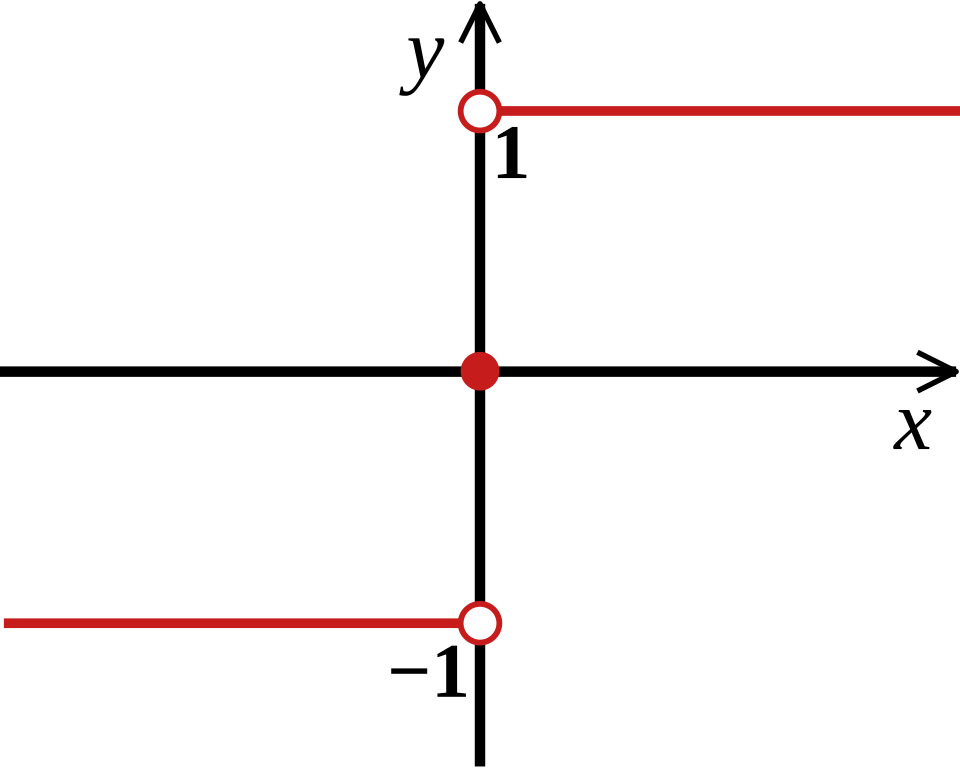 Image: Signum function, CC BY-SA 3.0

A step that jumps from to at the origin. The value at is a convention; since we only ever integrate it, the point value doesn’t matter, and many texts drop the clause and let the function jump straight from to .
Relation to the unit step
The signum and the unit step are linearly related:
Either one builds the other. In practice the unit step is the workhorse; the signum shows up occasionally as a building block, mainly when the symmetric form is more convenient than the asymmetric form.
Fourier transform
The signum has only an “AC” part (no DC component), so its spectrum is purely , blowing up at . By comparison, the unit step has the same AC tail plus a half-impulse at the origin for the DC piece: .