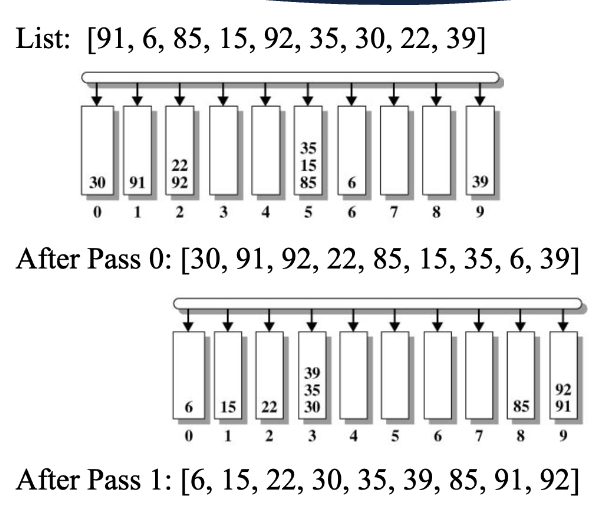
Radix sort sorts integers (or fixed-length strings) by processing one digit at a time, from least significant to most significant (or vice versa). At each digit position, distribute elements into 10 buckets (one per digit value 0–9) using a stable sort like counting sort, then concatenate. After processing the most significant digit, the array is fully sorted.
Like Bucket sort, it doesn’t use comparisons — it exploits the structure of the data (integers as digits). Runs in time per digit position, total where is the number of digits.
Algorithm (LSD = least-significant-digit first)
- Find the maximum value in the array — this tells you how many digits to process.
- For each digit position (1, 10, 100, …):
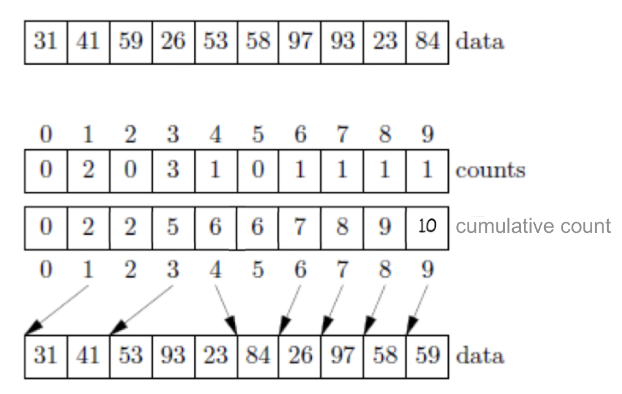
- Count the occurrences of each digit (0–9).
- Use the counts to determine each element’s output position.
- Place each element in its output position. Stable order: elements with the same digit retain their relative order.
- After processing the most significant digit, the array is sorted.
void radixsort(int array[], int size) {
    int max = getMax(array, size);
    for (int place = 1; max / place > 0; place *= 10) {
        countingSort(array, size, place);
    }
}
The countingSort helper sorts by a single digit position. It’s a stable Counting sort applied to the digit at the chosen place value (the iteration must be backward through the input to preserve stability — that’s what carries relative order across digit passes). For the full counting-sort algorithm and analysis, see Counting sort.
Big O
For elements with digits each:
- Each digit pass: where is the radix (10 for decimal). Effectively for fixed radix.
- Total: .
When is constant (e.g., 32-bit integers), radix sort is — faster than the lower bound for comparison sorts.
Why it’s not comparison-based
The lower bound applies only to algorithms that learn about the data through comparisons. Radix sort doesn’t compare values — it inspects digit positions directly. So the lower bound doesn’t apply.
The cost: radix sort only works on data that has digits to inspect. Floats, strings, custom objects with a comparison function — none of those are directly amenable. Radix sort can be adapted for fixed-length strings (process one character at a time), but for arbitrary objects, comparison sorts are still the standard.
When to use it
- Fixed-width integer keys: network routing tables, pixel intensities, record IDs.
- Strings of bounded length: phone numbers, ZIP codes.
- Large integer arrays where the constant factor matters. Radix sort can beat quicksort here in practice.
LSD vs MSD
- LSD (least-significant-digit first): process the smallest digit first, work up to the largest. Standard form, easy to implement, has to process all digits.
- MSD (most-significant-digit first): process the largest first, recurse on each bucket. Handles variable-length keys and can stop early if a prefix already settles the order. More complex.
Most descriptions (including this one) use LSD.
Related: Bucket sort distributes by value range instead of by digit.