The power-sizing model estimates the cost of a new project from a known cost of a similar project at a different size. It assumes economies of scale, so cost grows more slowly than size:
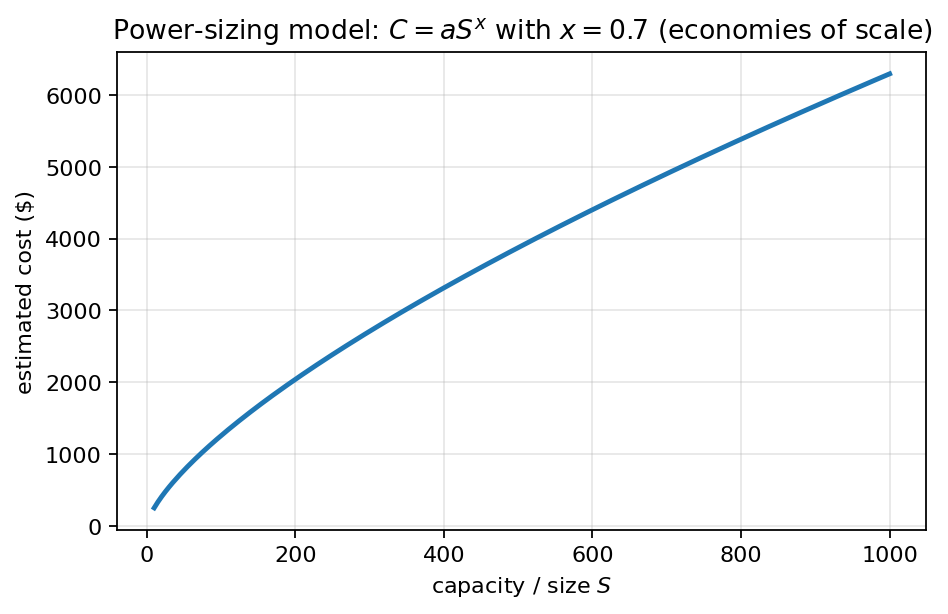 Power-sizing cost estimate with ; concavity captures economies of scale.
where is the cost of the known reference project at size , is the cost being estimated at the new size , and is the cost-capacity exponent (also called the cost-size or power-sizing factor).
The exponent controls how cost scales with size. Three regimes:
- — economies of scale. Doubling size multiplies cost by , so cost per unit of capacity falls as size grows. This is the regime for nearly all engineering equipment.
- — no scale effect. Cost is linear in size; cost per unit of capacity is constant.
- — diseconomies of scale. Cost grows faster than size, usually because you’ve crossed a capacity threshold (different foundation, different design code, higher steel grade, more complex controls).
For chemical-process equipment, is so common that the rule is often called the “six-tenths rule”: doubling the size multiplies cost by , not by 2. Larger equipment is cheaper per unit of capacity because shells, foundations, and instrumentation don’t scale linearly with throughput.
Typical exponents (rough): heat exchangers , storage tanks , compressors , refineries . Buildings tend toward , bigger buildings costing less per square foot for the same reason. Civil works (roads, pipelines) tend higher, closer to -, because cost is more closely tied to length.
Use power-sizing when you have a reliable cost data point for a similar item at a different size, and the historical exponent for the category is known or can be looked up. Expect budgetary-grade accuracy (±10-20%).
Extrapolating across more than a factor-of-3 or so in size, the exponent itself may shift. Past some scale point you may need different equipment topology entirely, and the cost curve takes a step. Use power-sizing within the regime it was fit to.
See also Parametric cost estimation and the overall hierarchy in Cost estimate classes.