Heap sort sorts an array in two phases: build a max-heap from the array, then repeatedly extract the maximum and place it at the end. Runs in in all cases — best, average, and worst — and sorts in place (no auxiliary array needed).
The two phases:
- Heapify: rearrange the array into a max-heap. The largest element ends up at index 0.
- Extract repeatedly: swap the root with the last element of the heap, then re-heapify the (now smaller) heap. The extracted maximum is now at the end. Repeat.
After all extractions, the array is sorted in ascending order.
Phase 1: build the heap
A max-heap has every parent ≥ its children. To turn an arbitrary array into a max-heap:
- Find the index of the last non-leaf node: .
- Starting from this index and moving back to the root, sift down each node: compare it with its children and swap with the larger child if the heap property is violated. Continue sifting until that subtree satisfies the heap property.
After visiting every non-leaf node bottom-up, the entire array satisfies the heap property — arr[0] is the maximum.
The leaf nodes (indices to ) trivially satisfy the heap property by themselves, so we skip them.
Cost of build: , not as you’d guess. The work is bounded by the sum of node heights across all levels, and that sum converges to a linear total.
Phase 2: extract
After building the heap, the array conceptually has two regions: the heap (front) and the sorted suffix (back). Initially the entire array is heap and the sorted region is empty.
Repeat:
- Swap
arr[0](the heap’s max) witharr[heapEnd](the last position in the heap region). The max is now at the end of the array. - Decrement the heap size by 1 (the last position is now the start of the sorted region).
- Re-heapify the new root (sift down from index 0). The new max bubbles to position 0.
After such extractions, the heap region shrinks to one element and the sorted region holds everything else in ascending order.
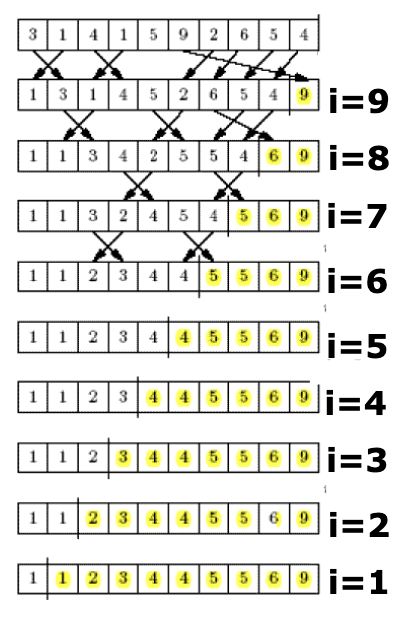
Worked example
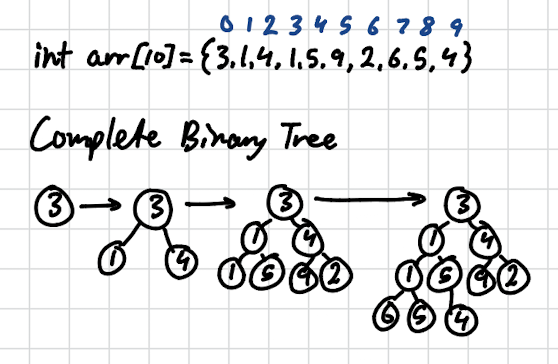
For arr = [3, 1, 4, 1, 5, 9, 2, 6, 5, 4] ():
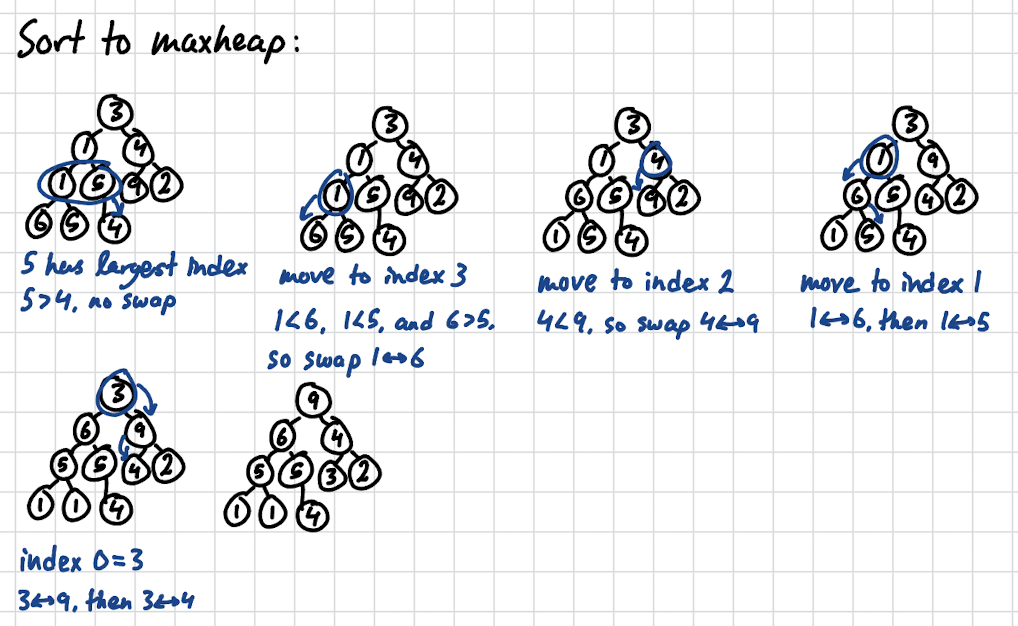
Build the heap. Last non-leaf is at index . Sift down from index 4 down to index 0. Each sift moves an element to its correct position in the heap.
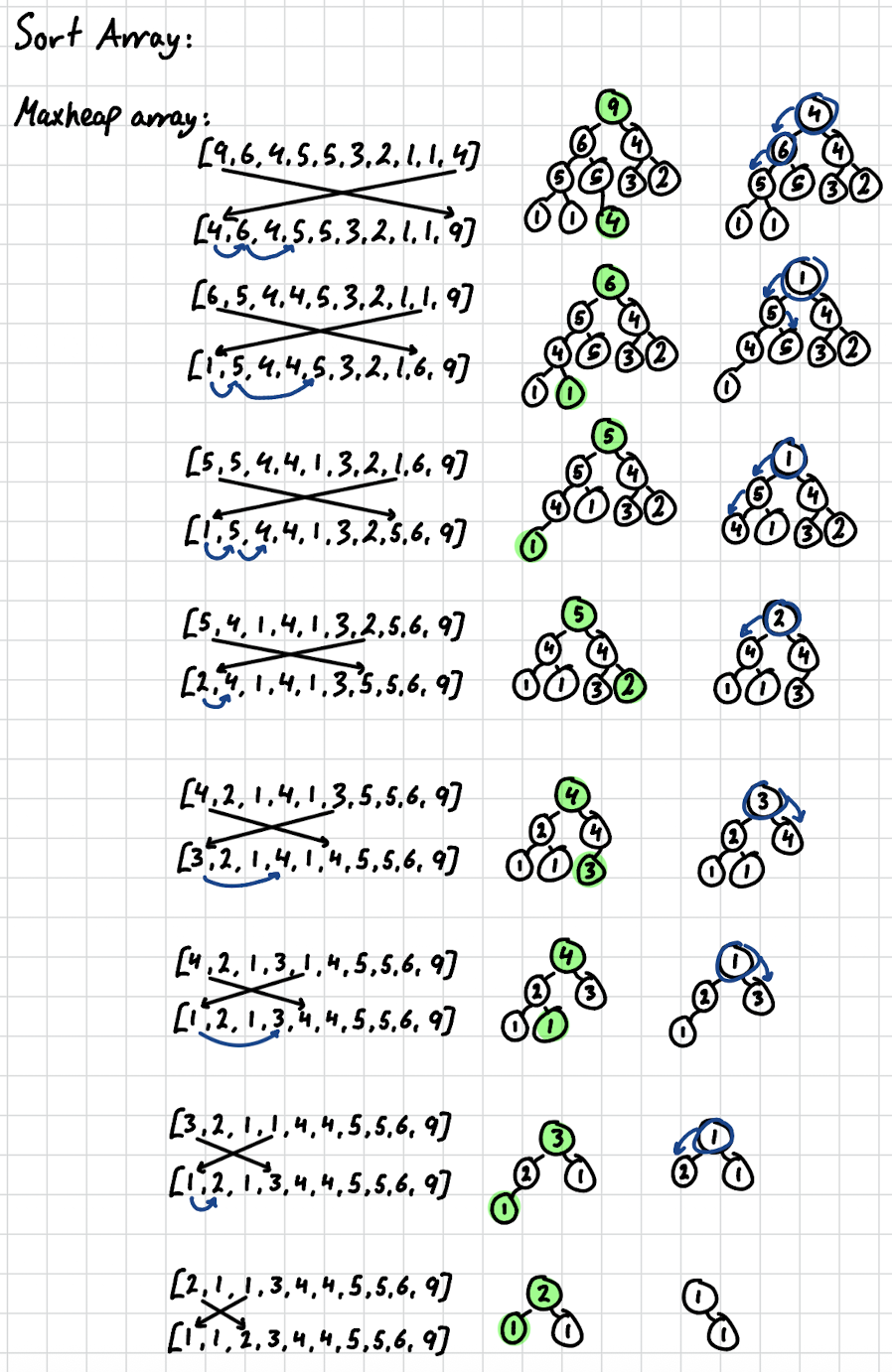
Extract. Swap root with end, shrink heap, sift down. Repeat.
After all extractions:
Big O
- Build: .
- Each extract: .
- Total extract phase: .
- Overall: .
This is the same asymptotic complexity as Merge sort and average-case Quick sort.
Properties
- In place: extra space (besides the array itself).
- Not stable: equal elements can change relative order during sift operations.
- Worst case = best case = average case = O(n log n): no input pattern degrades it. (Compare with quicksort’s worst case.)
When to use it
Heap sort is useful when:
- You need guaranteed worst-case performance (quicksort can degrade).
- Memory is tight ( extra space, vs. merge sort’s ).
- Stability isn’t required.
In practice quicksort beats heap sort by a constant factor on real workloads (better cache behavior, fewer swaps), so heap sort is usually a fallback rather than the default.
Same machinery as heap-based priority queues: build a heap, sift up on insert, sift down on extract. The difference is that sorting runs this as a one-shot in-place transformation instead of maintaining a queue over time.