Drain-to-gate feedback bias is a single-resistor MOSFET biasing scheme: connect a large resistor from the drain back to the gate. It does two jobs at once. It forces the device into saturation automatically, and it provides Negative feedback that stabilises the bias point.
It guarantees saturation
Because the gate draws no current (Gate oxide), no current flows through in DC, so there is no voltage drop across it and the gate sits at the same DC potential as the drain:
The saturation condition is . With we have , and since , is automatically satisfied whenever the device conducts. So a drain-to-gate connected MOSFET is always saturated when on, the same reasoning as the Diode-connected MOSFET but with a large resistor in the gate path instead of a short. It can’t slip into triode.
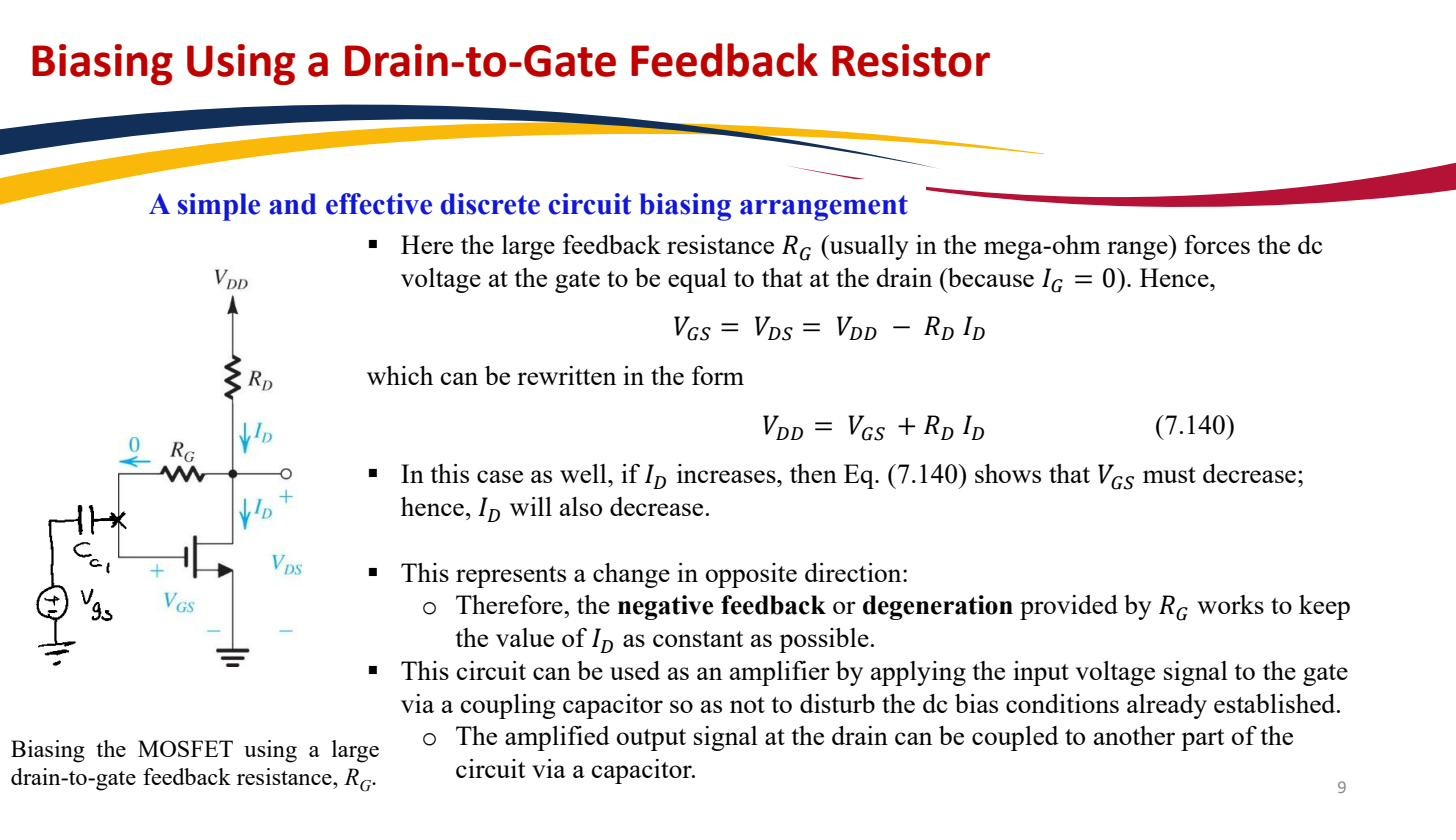 Drain-to-gate guarantees saturation and gives negative-feedback bias stabilisation.
The negative-feedback loop
Trace what happens if drifts up (a low- part, a temperature rise):
The rising current pulls the drain (and therefore the gate) down, which reduces , which pushes the current back down. A self-correcting loop, the negative-feedback bias-stabilisation idea behind MOSFET biasing done with one resistor. The BJT analogue is collector-to-base feedback bias, identical mechanism (a resistor from collector to base). The trade-off, as with any feedback bias, is that also feeds signal from drain to gate, which lowers the AC input resistance via the Miller effect. For biasing purposes the guaranteed saturation plus stabilisation from a single component is hard to beat.