The classic demonstration that Ampère’s law needs the Displacement current term once things vary in time. Without it, Ampère’s law gives contradictory answers depending on which surface you pick, even though both surfaces share the same boundary loop.
The setup
A parallel-plate capacitor in a circuit being charged by current flowing in the connecting wires. Pick a closed loop that encircles one of the wires, just outside the capacitor.
By Stokes’ theorem, any surface bounded by can be used to compute the surface integral side of Ampère’s law. Two natural choices:
Surface : a flat disc that cuts through the wire. Conduction current passes through it: .
Surface : a “bulged” surface that bulges out and passes between the capacitor plates without intersecting any wire. No conduction current passes through it: .
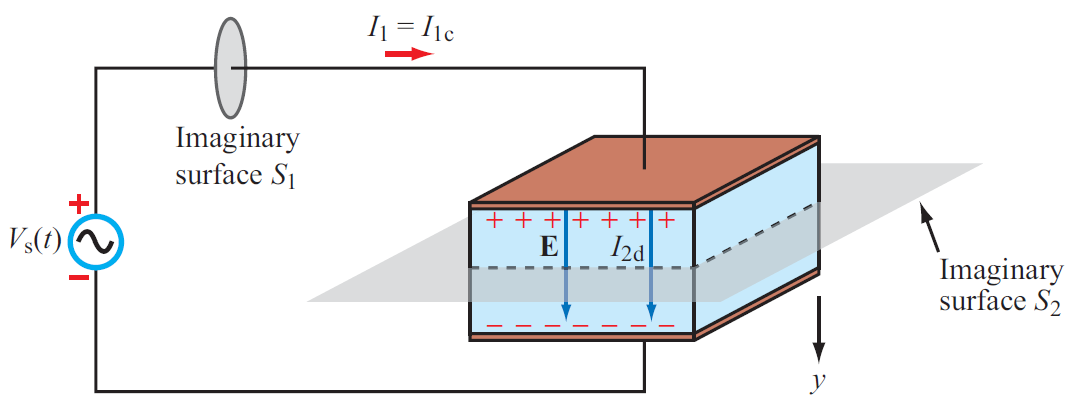 The same loop bounds both surfaces (cutting the wire) and (between the plates). Conduction current pierces but not .
The pre-Maxwell paradox
Without the displacement current term, Ampère’s law reads . Apply it to the same loop :
- With : .
- With : .
But is a single, well-defined number. It can’t equal both and 0. Contradiction. Either Ampère’s law as stated is wrong, or Stokes’ theorem doesn’t hold, or one of the surfaces must produce the same answer somehow.
Maxwell’s resolution
Maxwell added the displacement-current term:
In integral form:
Recompute both surfaces:
: . Between the plates of a capacitor, is essentially zero outside (negligible fringing), so . Total: . ✓
: (no wire pierces it). Inside the capacitor, pointing across the plates. So:
Total: . ✓
Both surfaces give the same answer, . The paradox is resolved.
Quantitative check
Take a parallel-plate capacitor of area , separation , dielectric permittivity , charged to charge at time .
Between the plates: , so .
Displacement current density: .
Total displacement current through area : .
The displacement current between the plates equals the conduction current in the external wire. Current is continuous through the capacitor, even though no charges physically cross the gap.
What this means physically
The displacement current is not a fiction; it’s a real source of magnetic field. The field measured around a circuit with a capacitor is the same whether you compute it from conduction currents (where they exist) or from (in the capacitor gap). Both formulations produce identical predictions for .
This is also why the picture “current flows through a capacitor” is roughly correct in AC analysis. The displacement current carries the magnetic effect of the time-varying flux across the gap; the conduction current pumps charge to and from the plates.
Why it’s more than bookkeeping
The displacement current term is needed for:
- Charge conservation. Taking the divergence of Ampère’s-with-displacement-current and using Gauss’s law automatically yields the Charge continuity equation . Without displacement current, charge would not be conserved by Maxwell’s equations.
- EM wave propagation. The coupling between and that creates self-sustaining electromagnetic waves requires the term. Without it, no light, no radio.
- Capacitor analysis at high frequency. AC currents through a capacitor are modeled as displacement currents in the dielectric; without this concept, the capacitor would appear as a discontinuity in the current path.
Worked example with numbers
A 1 nF parallel-plate capacitor charged by a 1 mA AC current at 1 MHz.
Conduction current: A.
Voltage: , with magnitude V.
The displacement current between the plates is again 1 mA (same magnitude as conduction current, since ). Around any loop encircling the capacitor, mA. The displacement current keeps Ampère’s law consistent.
In context
The cleanest demonstration of why Maxwell’s modification to Ampère’s law is needed; every intro EM text walks through some version of it. It’s also the prototype for the deeper point: EM theory only stays internally consistent (charge conservation, surface-independence of Ampère) once all four Maxwell terms are present.