The body effect is the increase in a MOSFET’s Threshold voltage when the body (substrate) terminal is held at a lower potential than the source. The body acts like a second, weaker gate (the back-gate), so reverse-biasing the body-to-source junction makes the device harder to turn on.
Why it happens
So far DC and small-signal analysis has assumed the body is tied to the source, so . In integrated circuits this often isn’t possible: many MOSFETs share one substrate, which sits at a fixed potential, so individual sources end up above the body. That means (body below source, a reverse bias on the body-source junction).
A reverse-biased body-source junction widens the depletion region under the channel. To form the channel, the gate must first support all that extra depletion charge before it can invert the surface. It has to “work harder,” so the gate voltage needed to reach inversion (the threshold) goes up. The relationship is
where is the threshold at (the nominal value), is the body-effect coefficient (a process parameter), is a quantity set by the substrate doping (around for typical doping), and is the magnitude of the reverse body-source bias. When the square-root terms cancel and , no body effect. As grows, climbs.
 Body = source ⇒ no body effect; .
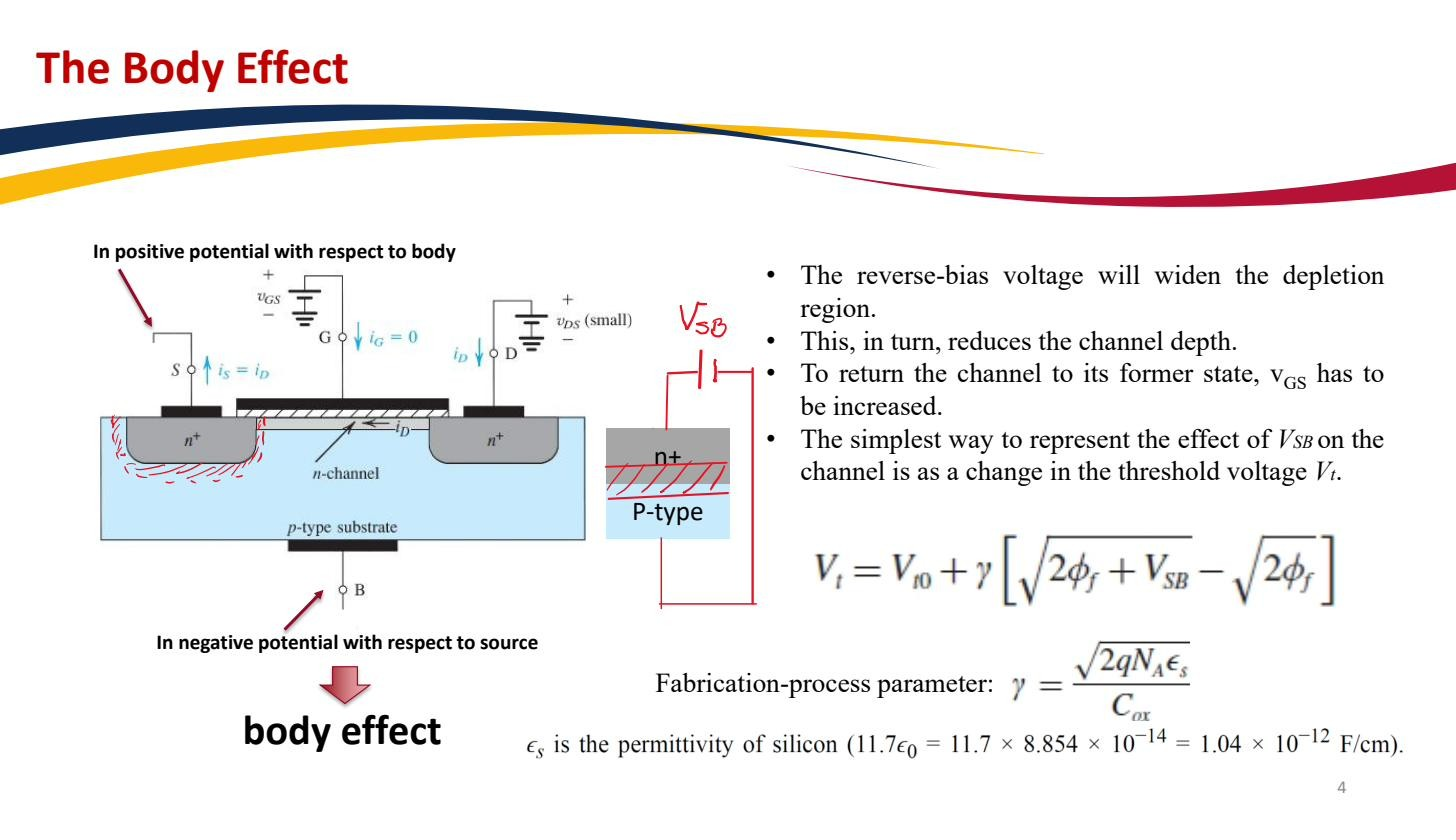 widens the depletion and raises effective .
Small-signal consequence: a second controlled source
If the body voltage can move relative to the source, then changes in change change : the body modulates the current. In the MOSFET small-signal model this shows up as a second voltage-controlled current source from drain to source, , in parallel with the main source. The body transconductance is proportional to (a fraction of it, set by and the bias).
In practice, in the discrete amplifier circuits in this course the body is tied to the source (), so drops out entirely and the body effect can be ignored. It matters in IC design with shared substrates and in stacked devices like source followers and cascodes, where source potentials differ from the substrate.